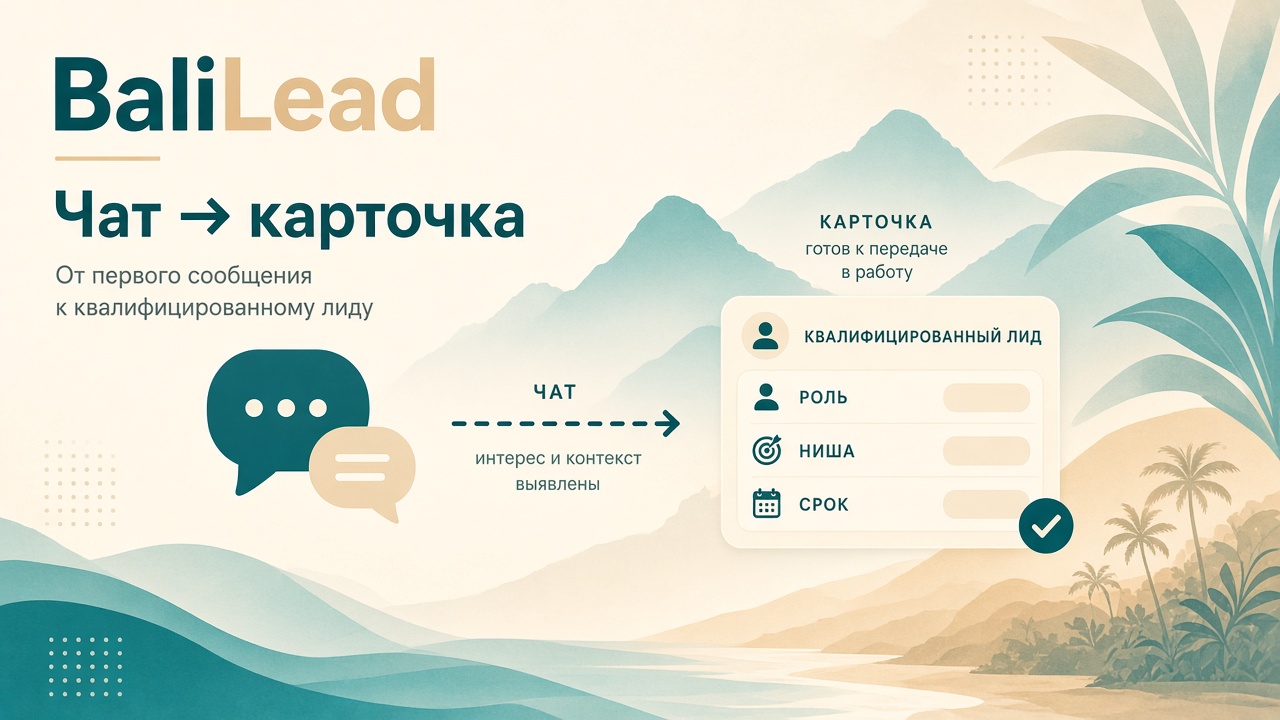
The query “bali leads” shows about 38 monthly searches in Yandex Wordstat for Russia as of September 2026. Behind it sits commercial intent: who sells inbound demand on the island, how to collect requests yourself, and what must reach CRM. This article is for buyers and users of such inbound — not an events guide and not a promise to cover the whole island. BaliLead catches demand signals in public Bali chats, qualifies them and hands sales a card with the source. Below is the buyer angle: what people mean, where the signal is, where the noise is, which fields managers need, and what not to promise.
What people usually want from this query
The commercial meaning is almost always one of three:
- buy ready inbound for a niche (villas, retreats, services, local B2B);
- understand who sells “Bali leads” and under which rules;
- build your own collection from public sources without manually copying chats.
Tourist intent is a different content job
Tourist interest (“where to go”) barely belongs to this keyword. If someone wants a poster or calendar, that is another intent and another article. Here the buyer matters: a sales team, a local business owner or a contractor who needs a stream of requests with a verifiable source.
Signal versus spam: what counts as a lead
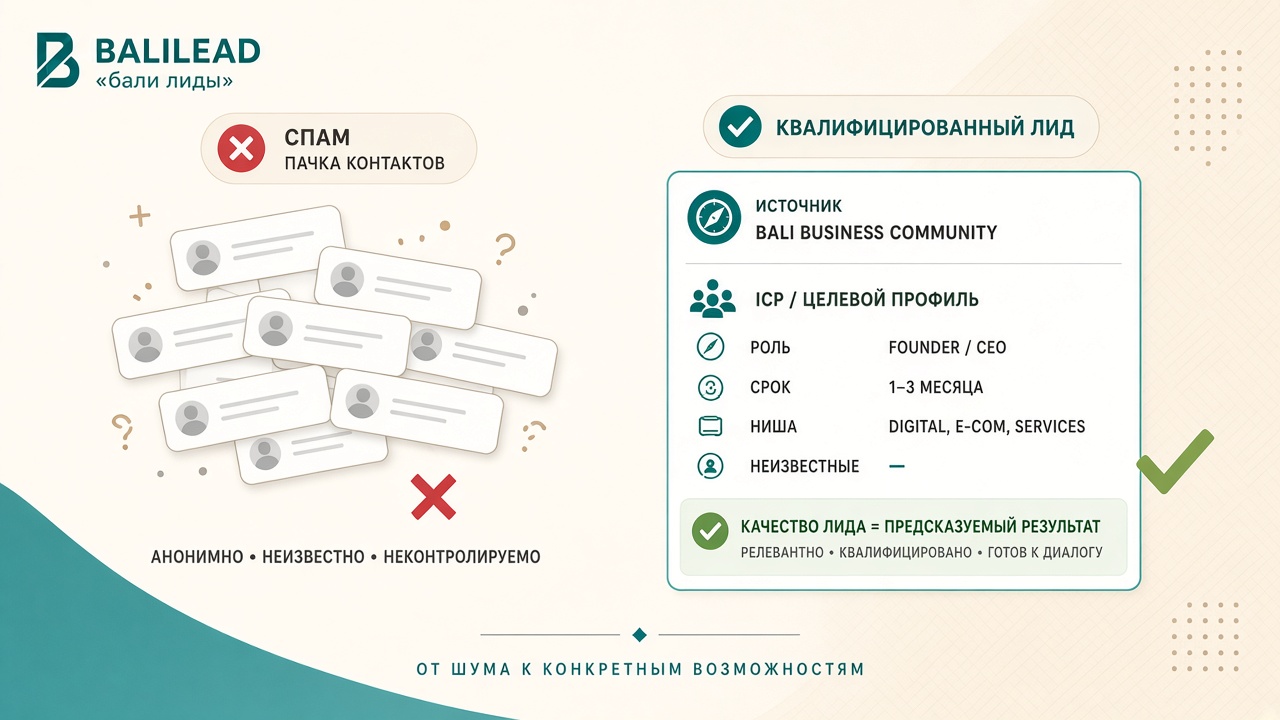
A lead is not any message that contains the word Bali. A lead is a fragment where buying, renting, ordering or finding a vendor is visible.
Useful phrasings:
- looking for a villa for a month in Canggu;
- need a contractor for a retreat in October;
- who builds websites / runs ads / does cleaning in Bali;
- recommend an agency / manager for a local launch.
What counts as noise
Noise includes:
- promoting your own offer with no request;
- mutual contractor promo;
- the same post in five chats with no new intent;
- asking for a restaurant with no commercial context.
Keep the original text and mark unknowns
Keep the original text and source link on the card. Looking for a villa on dates X is fine. Will definitely buy for Y is not, unless the message says so. Mark unknown fields explicitly.
Buyer ICP: who actually needs such inbound
A Bali lead buyer usually says yes when four conditions match:
- There is a product or service with a clear next step (call, showing, proposal).
- Someone will process the card the same day or the next.
- There are rules for a fit contact versus out of niche.
- There is a CRM or at least one shared list with a deal owner.
Good and bad ICP
Bad ICP: everyone who writes about Bali. Good ICP: a local business or contractor seeking intent-bearing requests and ready to clarify role, timing and area.
Minimum card fields for sales handoff:
- request summary in your words + original fragment;
- author role (customer, assistant, agency, HR);
- niche / product if clear;
- area or geo if stated;
- timing horizon;
- reply channel and language;
- what is unknown (budget, timing, role);
- source link and signal date.
How to hand the card into CRM
Minimum path for commercial use of inbound:
- Source is allowed for monitoring.
- Signal is saved with text and link.
- Checks: intent, role, duplicate, ICP.
- Card with the fields above and one next step.
- One sales owner: clarify, propose a format, pass to a specialist or close with a reason.
A useful next step
Useful: villa request for 4 weeks in Ubud — clarify budget and guest mix. Useless: send to sales with no context.
BaliLead helps collect the signal, filter obvious noise and hand over a sourced card. It does not turn every message into a deal or replace the manager’s decision. Boundaries follow allowed sources and team rules.
What not to promise a lead buyer
A short “no” list that protects trust:
- no guaranteed deal or fixed conversion;
- no claim to cover every island chat without a real connected-source list;
- no inventing budget or timing the signal never stated;
- no selling the same duplicate as several new leads;
- no promise that a manager can skip reading the original fragment.
An honest gap beats a pretty guess
If data is thin, write that on the card. An honest gap is more useful than a polished fantasy.
What to review after handoff — without invented metrics
Once a week, sample a small set of cards:
- share with source and original fragment;
- share with explicitly marked unknowns;
- time to ownership;
- merged duplicates and promo posts;
- close reasons: outside ICP, ad, duplicate, no reply, not relevant.
Takeaway
Those observations show where to fix the process. They do not replace the offer or the sales team.
This query is narrow in Wordstat and useful in meaning: commercial inbound on the island, not tourist content. For the buyer the path is simple: allowed source → intent signal → ICP → card with unknowns → one next CRM step.
Before launch, agree sources, commercial-request traits, dedupe rules and who owns first contact. Start with a narrow experiment. Expand only where cards stay verifiable.