
The query “bali events” is modest in Keyword Planner (~10 searches/month, LOW competition) and splits two audiences: tourists looking for what to attend, and organisers looking for people who need a venue, host or package. This article is for the second group. BaliLead catches demand signals in public Bali chats, qualifies them and hands sales a card with the source — here focused on the events niche.
Why events in Bali is a lead niche, not a content calendar
A calendar answers what is happening. Lead gen answers who is looking for a vendor or venue right now.
Useful intent phrases for organisers include:
- looking for a host for 40 people in Canggu;
- need a villa for a retreat in October;
- who runs team-building in Bali;
- recommend a photographer and catering for a private dinner.
A poster is not a signal
Festival news, poster reposts and “what to do this weekend” are noise even when the word event appears.
A niche is ready to monitor when four conditions exist:
- a source where people state a need;
- verifiable commercial-signal traits;
- rules that exclude posters and duplicates;
- an owner for the next step after the card.
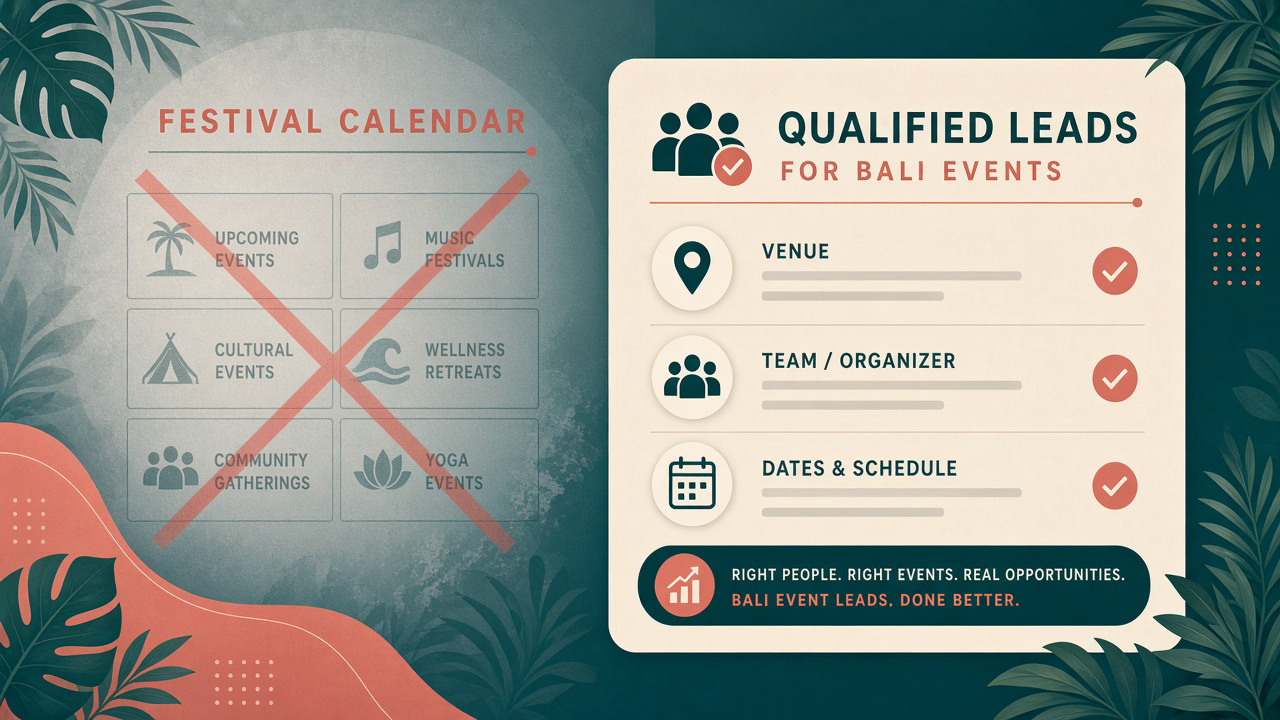
Typical signals for events and experiences
Judge the author’s action, not the keyword. In Bali you more often see venue requests, team needs (host, photo/video, catering, decor, transport, coordinator), format packages (retreat, corporate, wedding, birthday, workshop), constraints (date, area, language, group size), and repeat partner requests for the next run.
Keep the original fragment and link on the card. Looking for a retreat villa on dates X is fine. Will definitely buy package Y is not, unless the text says so. Mark unknown fields explicitly.
Organiser ICP: who reaches sales
The ICP should stop unfit contacts before a manager sees them. For Bali events, specificity beats anyone who wrote about events.
Minimum card fields: event type, author role, area if stated, date horizon or ASAP, group size if known, what is already in place vs missing, reply language and channel.
Good ICP example: an organiser seeking a vendor or venue for a private Bali event and ready to clarify the format. Bad ICP: everyone who typed the word event.
Posters, ads and duplicates
Noise is dense: announcements, ticket links, mutual contractor promo, one poster across five chats.
Check four axes: intent (buying vs selling), role (customer/coordinator vs constant promoter), repetition (same poster/object already on a parent card), and context (date, area, group size vs hashtags only).
If a new comment adds dates or group size to a known request, attach it to the parent card. A repeat with no new intent is a duplicate, not a new lead. Write date unknown instead of inventing certainty.
From signal to CRM card
Minimum path: allowed source, signal with original text and link, intent/role/duplicate/ICP checks, card with format/area/dates/group size/needs/unknowns/next step, one sales owner and one concrete action.
Useful next step: Anna, private dinner for 12 in Ubud this weekend — confirm catering and venue availability. Useless: send to sales.
BaliLead helps collect the signal, keep context, filter obvious noise and hand over the card. It does not turn every chat into a deal or replace the manager’s decision.
What to review after handoff
Weekly, sample a few event cards: share with source and original fragment, share with explicit unknowns, time to ownership, merged duplicates/posters, and close reasons (outside ICP, ad, duplicate, no reply, not relevant).
Those numbers show where to fix the process. Do not replace them with invented conversion promises — the deal still depends on the offer and the team.
Before launch, agree sources, commercial-request traits, poster dedupe rules and who owns first contact. Start narrow; expand only where cards stay verifiable.